
Jiro Yoshihara, 1965

Jiro Yoshihara, 1965 (detail)

Jiro Yoshihara, 1965

Atsuko Tanaka, 1956

Saburo Murakami, 1963
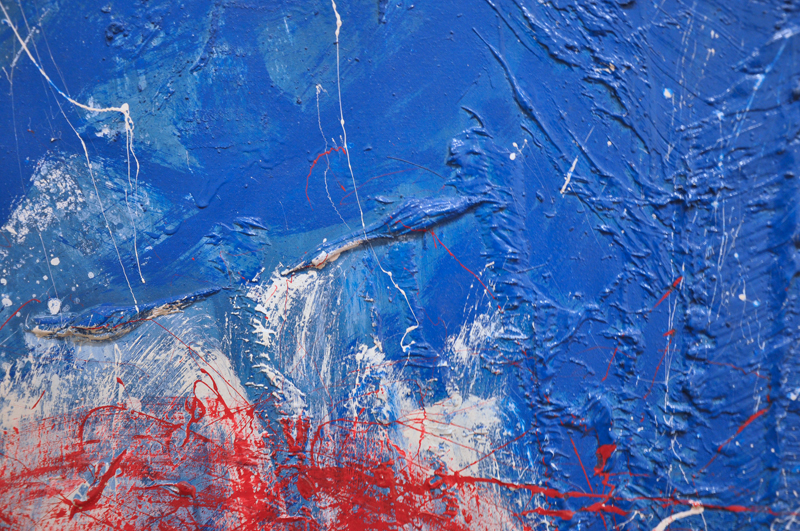
Saburo Murakami, 1963 (detail)

Saburo Murakami, 1963 (detail)

Saburo Murakami, 1957
From the Press Release
New York, NY… After World War II, a devastated Japan processed the impact of the atomic bomb and faced a cultural void. It was in this atmosphere of existential alienation that the Gutai Art Association (Gutai Bijutsu Kyokai) – a group of about twenty young artists, rallying around the charismatic painter Jiro Yoshihara – emerged in the mid-1950s to challenge convention. Although keenly aware of Japan’s artistic traditions, the Gutai artists attempted to distance themselves from the sense of defeat and impotence that pervaded their country, and to overcome the past completely with ‘art that has never existed before’. They burst out of the expected confines of painting with daring works that demonstrated a freewheeling relationship between art, body, space and time. Dismissed by Japanese critics as spectacle makers, the Gutai artists nevertheless produced a profound legacy of aesthetic experimentation, influencing Western critics and anticipating Abstract Expressionism, Arte Povera, Fluxus, and Conceptual Art.
The Gutai Art Association was formed by Jiro Yoshihara in July 1954, in the Ashiya region of Japan. Exhorting younger artists with such slogans as, ‘Don’t imitate others!’ and ‘Engage in the newness!’. Yoshihara challenged Gutai’s members to discard traditional artistic practices and to seek not only fresh means of expression but the origins of artistic creation itself. The Gutai artists responded with performance, installation, flower arrangement, and music, often in public places. In seeking to define this constantly changing body of work, Yoshihara penned The Gutai Art Manifesto in 1956, proclaiming ‘the novel beauty to be found in works of art and architecture of the past which have changed their appearance due to the damage of time or destruction by disasters in the course of the centuries…that beauty which material assumes when it is freed from artificial make-up and reveals its original characteristics.’ Yoshihara concluded the Manifesto by stating, ‘Our work is the result of investigating the possibilities of calling the material to life. We shall hope that there is always a fresh spirit in our Gutai exhibitions and that the discovery of new life will call forth a tremendous scream in the material itself’.
At a time when a majority of Japanese artists had adopted a Western approach to creating and criticizing art, Gutai’s ideas and works were repeatedly met with the question, ‘Is this art?’. What established Gutai as entirely unique was the fact that no one, often including the movement’s own members, could predict the group’s course and the manifestations its work would take. Gutai’s imperative to continually create something surprising took its artists in new directions, leading Yoshihara to ask himself, ‘whether or not the production process was stamped with the instant of creation as proof of the fierce desire to affirm a vivid sense of adventure and a free spirit’.

Shozo Shimamoto, 1962

Sadamasa Motonaga, 1965

Sadamasa Motonaga, 1965 (detail)

Shozo Shimamoto, 1993

Shozo Shimamoto and Kazuo Shiraga, 1965

Sadamasa Motonaga and Kazuo Shiraga

Sadamasa Motonaga, 1963

Sadamasa Motonaga, 1963 (detail)

Sadamasa Motonaga, 1963

Sadamasa Motonaga, 1963 (detail)

Installation view

Installation View

Tsuruko Yamazaki

Norio Imai

Norio Imai (detail)

Installation view w/ Shuji Mukai, 1963 (on right)

Atsuko Tanaka

Atsuko Tanaka

Atsuko Tanaka (detail)

Takesada Matsutani, 1965

Yasuo Sumi
A Visual Essay on Gutai
Sept. 12 - Oct. 27, 2012
New York NY 10021
Comments